
News
The Case For Culturally Competent Leadership In News Media
August 1, 2023
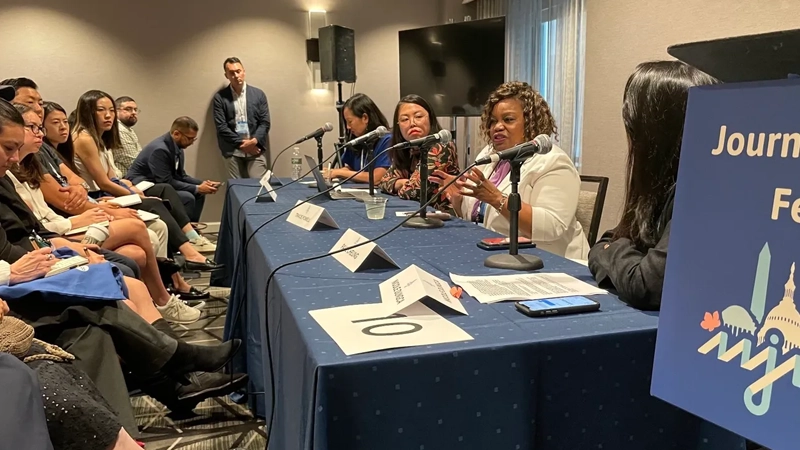
Recently in Washington, D.C. to attend the 2023 Asian American Journalists Association Conference, I told a packed room how The Pivot Fund does funding differently than other journalism donors. Unlike other funders, we center communities in our giving strategy and provide culturally competent leadership.
What do we mean by culturally competent? Three principles are core to how we operate and what we look for when we make grants. They are:
- The Pivot Fund is flexible and adaptive to community information needs. We ask questions and learn directly from the community and audience members. We look for potential grantee partners who do the same. We invest in newsrooms that understand and honor the histories, cultures, languages, and traditions of the communities they serve. These newsrooms value and respect different capacities and abilities. Just as The Pivot Fund is seen as a trusted partner by BIPOC newsrooms, they, in turn, are trusted by their communities to deliver critical news and information in the language most accessible to their audiences and community members. For BeeTV in Lagrange, Ga., this means producing go-to sports coverage that brings together a racially divided community. For Pasa la Voz in Savannah, Ga., it means producing critical news and information in Spanish and a syntax its immigrant community comprehends.
- The Pivot Fund actively listens to what community members and audiences have to say and what they don’t say. We ask clarifying questions as good journalists do. We do the same when it comes to courting potential grantee partners. Deep listening can reveal much information about things your biases wouldn’t have allowed you to hear. If funders listened more to community members, they’d better understand how people consume information, how they access it, what they do with it, who they trust, and why.
- Those closest to societal problems often have the greatest insights into how to address them. The Pivot Fund takes a collaborative problem-solving approach that invites and empowers communities to decide who and what gets funded. We look for media companies that produce news and information not just for and about their audiences and communities but alongside them. We can’t go it alone in solving some of our biggest challenges. We can address issues more effectively by collaborating to address challenges or question what’s in play.
Expectations are different in today’s news environment. News outlets can no longer skate and ignore swaths of their audiences or what kinds of information they need or want. Now people have higher expectations about what they want from journalism,
As funders, we can’t just show up and be tone-deaf. We have to know who’s in the room, and we have to listen. We must understand, appreciate and interact with people from a broad range of backgrounds, experiences, and viewpoints with respect. Cultural competency is just competency.
If you’d like to learn more about this topic, the National Association of Hispanic Journalists produced the Cultural Competence Handbook designed to accompany the Associated Press Stylebook and other style guides used in leading U.S. newsrooms.