
Analysis
Webinar Takeaways: How Community Media Earns Youth Trust
March 4, 2026
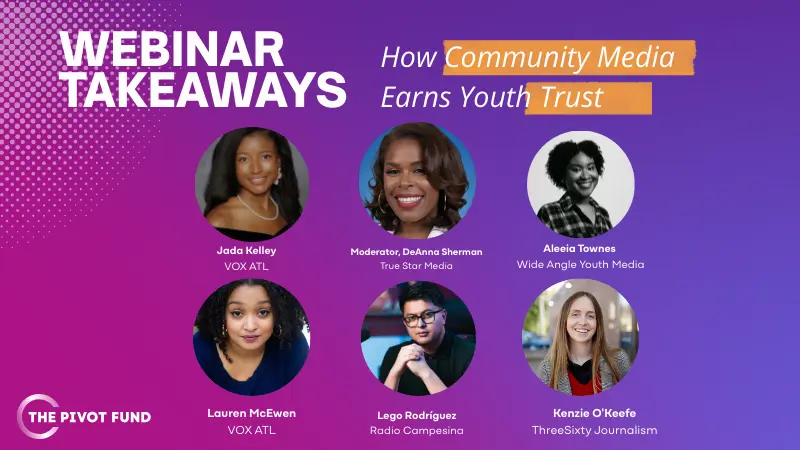
As media habits shift and trust in institutions declines, community publishers face an urgent question: How do we build meaningful relationships with younger audiences?
During The Pivot Fund’s recent webinar, How Community Media Earns Youth Trust, youth journalists and leaders from organizations including VOX ATL, a teen-driven publishing platform in Atlanta; ThreeSixty Journalism, a Minnesota-based youth journalism training program; Wide Angle Youth Media, a Baltimore media arts education and creative studio; and Radio Campesina, a trusted Spanish-language community radio network, shared lessons from their work.
One takeaway stood out: trust with young audiences isn’t built through algorithms — it’s built through participation.
“This work is deeply relational,” said True Star Media Co-founder and Executive Director DeAnna Sherman, who moderated the webinar. True Star is a Chicago-based organization that empowers underserved youth through digital media training and real-world creative work, and is discussed in The Pivot Fund’s Great Lakes news ecosystem research. “It’s about trust, belonging and participation.”
Participation builds trust
Young people are far more likely to trust media organizations that invite them into the storytelling process.
Programs such as youth reporting fellowships, advisory boards, and partnerships with youth media organizations allow young people to pitch ideas, report stories, and shape coverage.
“When it comes to engaging young people in the news-making and news-consuming, you have to be in real relationship with them,” said Kenzie O’Keefe, executive director of ThreeSixty Journalism. “Know the young people in your community, engage with them in mutually beneficial ways. There are no shortcuts.”
VOX ATL teen board member, intern and former Atlanta Teen Voices Journalism Fellow Jada Kelley described how meaningful that participation can be when youth voices are treated as equals in the newsroom.
“At Vox, I’m able to be seen and heard, and at the same level as with the adults,” Kelley said. “We’re able to have mature conversations where we listen to one another.”
For publishers, the message is clear: treating young people as collaborators — not just consumers — builds lasting engagement.
Authenticity matters
Panelists noted that young audiences quickly recognize when media organizations try too hard to mimic youth culture. Attempts to adopt slang or trends often feel forced.
What resonates more is transparency, representation, and a genuine connection to community.
Aleeia Townes, a junior designer with Wide Angle Youth Media, which partners with Pivot grantee, The Baltimore Beat, said representation plays a major role in whether young audiences trust a news outlet.

“I’m more trusting of media outlets when I see that they have good representation, and when they’re honest about the information they’re giving out,” Townes said.
Accessibility also shapes trust. Many young people notice when news organizations make an effort to reach communities that are often overlooked.
“I do have respect for outlets that cater to communities that may not even have access to internet, or may not be able to pay for subscriptions to get news,” Townes added.
Meet young audiences where they gather
Reaching young audiences also requires understanding where they already spend time and how they engage with information.
Radio Campesina reporter and content creator Lego Rodríguez shared how platforms like YouTube help reach younger audiences with stories and conversations relevant to their lives. But he also noted that participation often happens in smaller, more private digital spaces.

Young people, he said, are often far more active in closed networks like Discord, where they feel more comfortable sharing opinions, asking questions, and expressing themselves freely.
Radio Campesina is a Pivot grantee, based in Arizona. They used Pivot dollars to hire Rodríguez to reach younger audiences. Since joining the team, his streaming video show, El Malcriado — a lively blend of culture, conversation, and journalism designed to resonate with younger Latinos — has sparked dialogue around issues often overlooked by traditional outlets.
Panelists also emphasized that engagement isn’t only about platforms — it’s also about spaces.
As traditional “third spaces” for young people become harder to find, VOX ATL Program Director Lauren McEwen said community media organizations have an opportunity to create gathering places where young people can connect, share ideas, and participate in storytelling.
Rebuilding the journalism pipeline
Another challenge facing the industry is the decline of journalism education in schools. Without early exposure, many young people never learn how journalism works or why it matters.
Youth journalism programs, school partnerships and mentorship opportunities can help rebuild that pipeline and introduce the next generation to civic reporting.
“When young people have opportunities to tell their own stories,” said True Star’s Sherman. “They begin to see themselves as part of the information ecosystem.”
The bottom line
For publishers trying to reach younger audiences, the lesson isn’t about chasing platforms or trends.
Trust grows from participation, representation, and relationships.
When young people are invited into the reporting process — and see themselves reflected in the work — they are far more likely to engage with and trust the journalism being produced.