
News
Mergers Are a Tool, Not a Strategy
July 6, 2026
Before journalism philanthropy decides which support organizations should merge, it should first answer a more fundamental question: Who is all of this for?
By Tracie Powell
Journalism philanthropy has entered an important moment of self-examination.
As funding becomes more constrained, leaders are asking difficult but necessary questions about the future of journalism support organizations. Should organizations collaborate more closely? Have too many intermediaries emerged? Should some organizations merge? Does the field need fewer institutions with greater scale?
These are important questions.
But they may also be incomplete.
Before journalism philanthropy decides how many organizations should exist, it should answer a more fundamental question:
Who is all of this for?
If the answer is journalism organizations, then consolidation, institutional efficiency and organizational sustainability become the obvious priorities.
But if the answer is communities, then every conversation—from mergers to infrastructure to governance—must ultimately be judged by whether it improves public access to trusted information.

Journalism support organizations are not an end in themselves. Neither are news organizations. They exist because healthy communities depend on trusted information, and no single newsroom can meet that need alone.
That is why journalism support organizations matter.
Some develop newsroom leaders. Others build technology, provide legal defense, strengthen business models, convene the field, conduct research, move capital or train journalists. Others work directly with communities, helping news organizations understand how people find, trust and use information.
These functions are different, but their purpose should be the same: helping journalism better serve the public.
Reducing this conversation to organizational charts risks obscuring why these organizations exist in the first place.
The question is not simply how many organizations journalism philanthropy should support.
The question is whether the ecosystem has the capacity to help communities access trusted civic information.
That means the goal of this debate should not be to build a smaller ecosystem. It should be to build a more effective one.
For more than a decade, philanthropy has invested hundreds of millions of dollars in local journalism. Those investments have launched nonprofit newsrooms, strengthened existing organizations, developed leaders, built technology and created a robust network of support organizations.
Many of those investments have been transformative.
Yet the underlying challenges persist.
Communities continue to lose access to trusted local information. News avoidance continues to rise. Trust remains fragile. Even nonprofit news organizations increasingly face layoffs, closures, mergers and financial instability.
If strengthening journalism organizations alone were enough, we would expect different outcomes by now.
That doesn’t mean philanthropy invested in the wrong organizations.
It may mean the field has been solving only part of the problem.
For years, journalism philanthropy has understandably organized its investments around strengthening institutions.
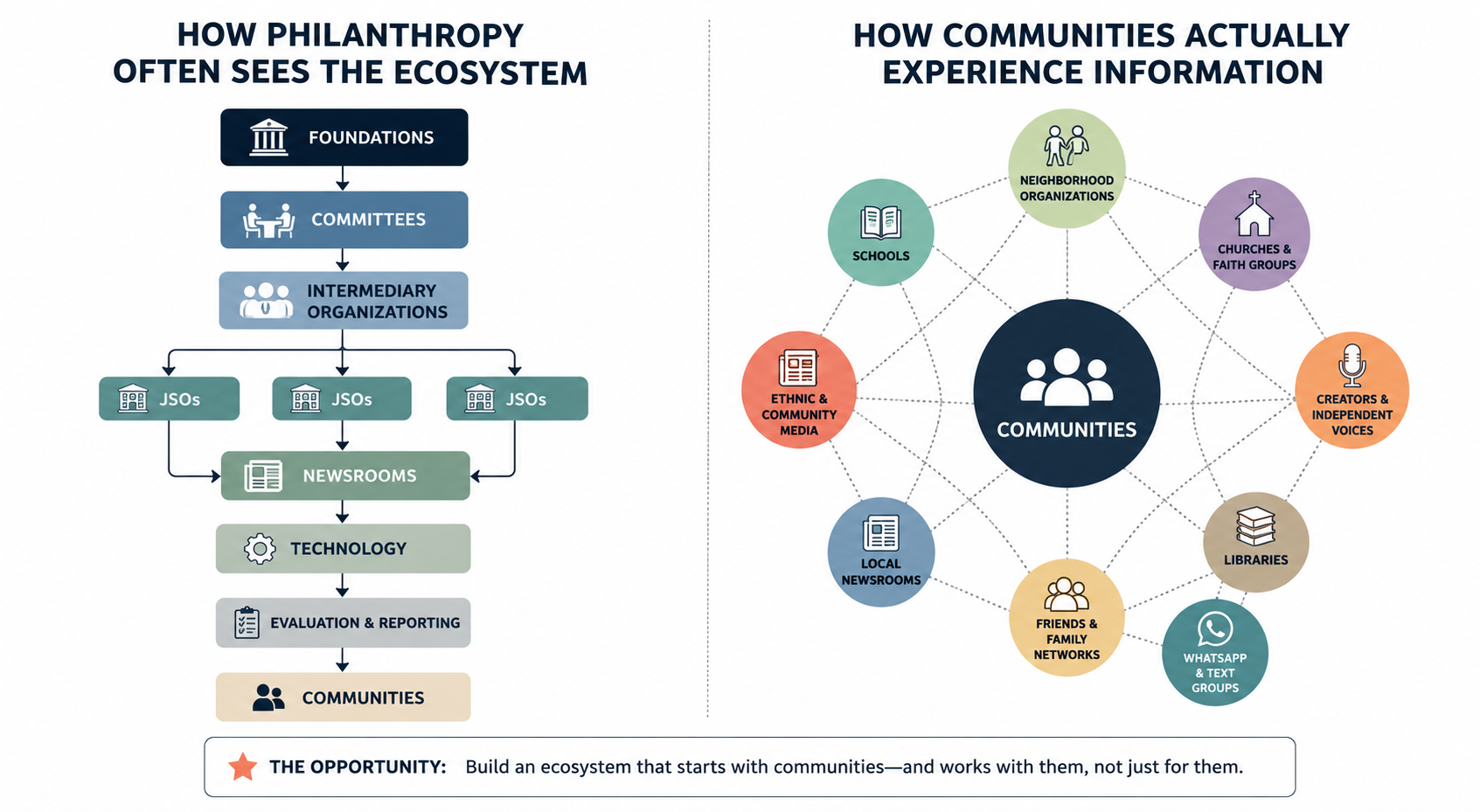
Communities organize their lives very differently.
People do not wake up wondering whether journalism survives.
They wake up wondering how to enroll their children in school, understand changing immigration policies, find affordable housing, prepare for severe weather, make sense of local elections, protect their families or navigate healthcare.
They are looking for trusted civic information.

Journalism remains one of the most important ways to provide that information. But increasingly, people receive it through trusted relationships—ethnic media, neighborhood publishers, creators, community organizations, churches, WhatsApp groups, YouTube channels, text messages and personal networks that often extend well beyond traditional newsroom websites.
The audience has moved.
Many community-centered publishers recognized this years ago because their audiences were never waiting on the homepage. They adapted because proximity to their communities required it.
Increasingly, the rest of the field is beginning to reach the same conclusion.
That shift should fundamentally reshape how philanthropy evaluates journalism support organizations.
The organizations best positioned to strengthen journalism over the next decade may not simply be those that help produce more journalism. They may be those that help journalism become more trusted, more relevant and more accessible to the communities it is intended to serve.
That is the difference between newsroom infrastructure and civic information infrastructure.
Newsrooms produce journalism.
Civic information infrastructure ensures journalism reaches people.
If communities are the point—not journalism institutions—then infrastructure should be judged by one question:
Does it help trusted information reach the people who need it?
The same standard should guide today’s debate about mergers.
Some organizations undoubtedly should collaborate more closely. Some mergers may eliminate unnecessary duplication or create stronger services. Some partnerships will almost certainly strengthen the field.
But mergers are a governance decision.
They are not, by themselves, a public strategy.
The measure of success should never be whether the ecosystem becomes smaller.
The measure should be whether communities become better informed.
That raises another important question.
Who gets to shape the future of journalism support organizations?
Every conversation about mergers, consolidation and infrastructure is also a conversation about power.
Because deciding how the ecosystem is organized is also deciding who gets to organize it.
These decisions determine whose expertise is valued, which approaches are scaled, which organizations receive sustained investment and, ultimately, who gets to define the future of local journalism.
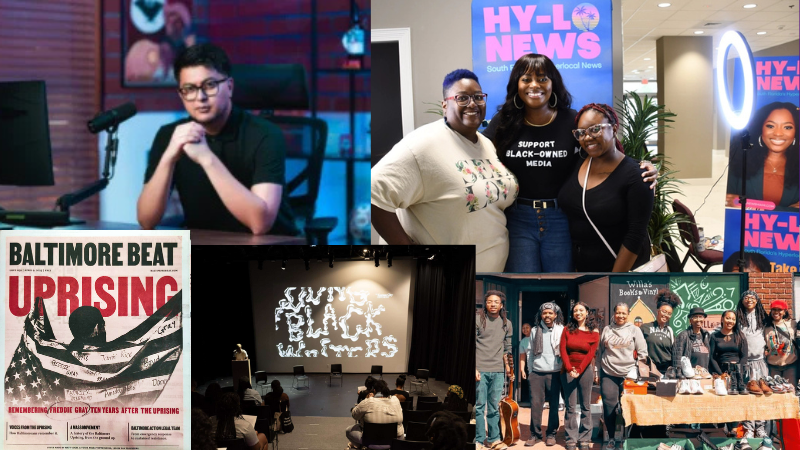
The Pivot Fund was created to address a gap in the journalism support ecosystem. We invest directly in community-rooted publishers while conducting research on how underserved communities find, trust and use information. That combination of grantmaking and field learning has shaped our work on civic information infrastructure, audience engagement and community-centered sustainability—issues that are now central to the field’s conversation.
Against that backdrop, The Pivot Fund was not invited to participate in last month’s Knight Foundation convening on the future of journalism support organizations.
I mention that not because every organization deserves a seat at every table. No convening can include everyone.
I mention it because it illustrates a broader governance challenge.
As philanthropy considers mergers and consolidation, it is also deciding which organizations will have the resources, credibility and influence to shape the field’s future. Those decisions continue to flow through the same institutional networks that have historically defined journalism philanthropy.
Organizations working closest to communities are frequently asked to contribute research, relationships and expertise. Their ideas are adopted. Their practices become part of the field’s conventional wisdom. Yet they are often absent from the rooms where long-term strategy is established and the future of the ecosystem is decided.
If journalism philanthropy is going to reshape the support ecosystem, it should broaden not only what it funds, but whose experience and expertise help define the field’s direction. Otherwise, we risk building a different organizational chart while preserving the same distribution of power.
Ultimately, that’s why the question “Who is all of this for?” matters.
Journalism support organizations exist to strengthen journalism.
Journalism exists to strengthen communities.
If our support organizations lose sight of that purpose, no amount of consolidation will save the ecosystem.
But if every decision—from mergers to grantmaking to infrastructure—is guided by how well it helps trusted information reach the public, then the future of journalism support organizations becomes much clearer.