
Resources
Four fast facts with MLK50’s new Chief Strategy Officer
April 7, 2023
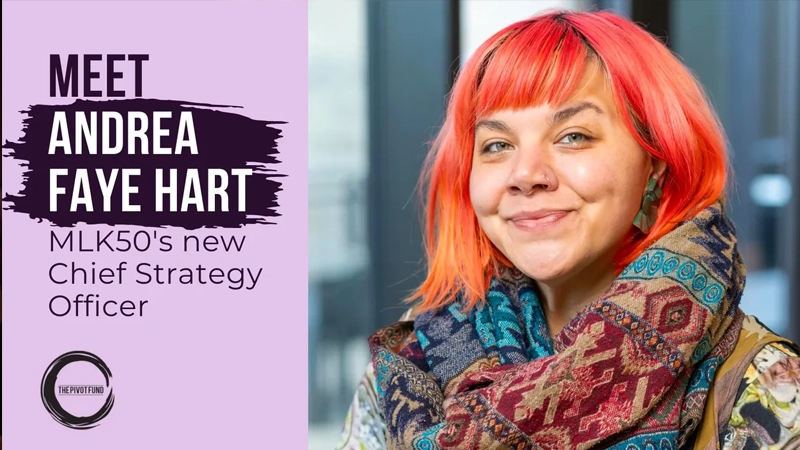
Just last month, trailblazer Andrea Faye Hart was promoted to MLK50’s top leadership team as the newsroom’s Chief Strategy Officer.
I first met her in Chicago when she was building out City Bureau, a journalism lab helping to reimagine our approach to local media, as a co-founder. It’s been a pleasure to witness Andrea’s leadership and growth in action over the last several years — from creating space for community-focused journalism to pursuing a master of divinity degree and now rising in her work at MLK50.
To commemorate Andrea’s new role we did a Q&A to learn more about her identity intersects with her work, what it means to be a Chief Strategy Officer, and what she aims to achieve in this role.
What does it mean to be MLK50’s Chief Strategy Officer?
This position means to be in stewardship of the mission and people at MLK50—to ensure the collective is cared for, the mission is practiced with integrity and that we are holding ourselves accountable to justice oriented-values as we grow. I’ve read somewhere that the CSO’s job is to not help make easy decisions, but the right one. I deeply relate to that, largely being the slow and quiet presence doing deep listening as MLK50 goes through transformative growth. In practice, this does not mean that I am a final decisionmaker but instead collect feedback/ideas amongst all staff and those we serve to discern our present as well as our path.
I have the honor to work most directly in concert with our founder, Wendi C. Thomas, and our executive editor, Adrienne Johnson Martin. I see this role as ensuring the sustainability of this organization so that our staff may continue to dream big on using journalism for justice in ways that changes the material reality of Memphians pushed to the margins.
What are your short-term and long-term goals for the organization?
MLK50 is about to turn 6 and that is a pivotal year. In the short-term, I want to expand and build off of the goals we had previously set, which include growing our revenue portfolio, growing our team and improving how we work together. In practice this looks like increasing our foundation partners who provide general operating support, experimenting with our major donor giving circle, setting up good recruiting/onboarding practices and creating a culture of feedback to assess what policies/care is needed internally. Long-term goals are driven by the needs of Memphians and the vision of our collective leadership. I believe in the long-run MLK50 will grow as a model for how to do this kind of community accountability and investigative journalism work.
At the same time, I think often not just about the sacrifice that King made in Memphis but also about how Ida B. Wells-Barnett was driven out of the same city for doing powerful work. I pay close attention to what the officials within this state are doing to the people we serve the people who make up this team. I take this work incredibly seriously and am personally motivated by two things: are we paying our people well enough so they can have full lives outside of this challenging work and are we being responsive to Memphians, are we putting money back in their pockets.
Why did you initially decide to join the MLK50 team? What resonated with you?
I knew I was going to leave my position at City Bureau and move to Nashville to pursue a Master’s of Divinity at Vanderbilt (or rather, I willed it to the universe and emailed Wendi before I even submitted my application.) I reached out to Wendi because I believe in place-based work and believed in what she was doing. I grew up poor, raised largely by a single mother so I lead with working class values—MLK50’s reporting and mission resonate with me. My mother has often referred to politicians as thieves and I hear echoes of that when Wendi says poverty is a robbery. My professional background has largely been in community-centered media-based organizing and education. I love how much MLK50 loves Memphians. That is radical practical work that as womanist Katie G. Cannon said, “my soul must have.”
Both you and Dr. Martin Luther King Jr. have degrees in divinity. Can you tell us a bit about your reflection on that connection?
I came to divinity school motivated by the solidarity and soul work that Dr. Martin Luther King Jr. and others had done during the 60’s civil rights movement because I was seeing the limitations of my work in Chicago to bridge deep divides in this country. I was especially interested in trying to understand what can be done to build solidarity amongst other white people to unlearn white supremacy culture and instead be co-learners/co-conspirators in all fights against injustice. I’ve been humbled and found great possibility through chaplaincy to steward this kind of anti-oppression training.
At the same time I believe in a ministry to move money, to build solidarity economies. Dr. Martin Luther King Jr. deeply understood the incredible power that could be built by bringing the civil rights movement and labor movement. It’s reflected in his critique of right-to-work: “In our glorious fight for civil rights, we must guard against being fooled by false slogans, such as “right to work.” It is a law to rob us of our civil rights and job rights.” I grew up in a household with a history of following “what would unions do” because of what they had done for my family. All of this adds up to a deep desire to understand, among many others, King’s principled struggle for not just changing policy but also equipping people to fight against the status quo.