
News
Apply or Pass? How to Know When a Grant Is Worth Your Time
September 22, 2026
A small independent newsroom recently came to us with difficult news: A longtime funder had decided it would no longer support the newsroom directly.
The grant was $150,000.
For a large institution, $150,000 might represent a line item. For a small newsroom, losing $150,000 can mean a reporter you can no longer afford. A beat that disappears. A community engagement program that gets scaled back. Or months of uncertainty while a publisher scrambles to replace revenue they thought they could count on.
The newsroom hadn’t suddenly become less effective. The community hadn’t stopped needing its journalism. The funder’s strategy had changed.
We’re seeing more of this across journalism philanthropy. Some funders are concentrating their dollars among a smaller number of intermediaries and journalism support organizations rather than making grants directly to newsrooms.
There are legitimate reasons for working through intermediaries. The Pivot Fund is one, and we believe deeply in what a good intermediary can make possible—particularly when it has the flexibility to move quickly and understands the organizations it serves.
We’ve seen that firsthand.
When Black By God, a community-rooted newsroom serving West Virginia, was at risk of losing its agriculture reporter after the loss of a major federal grant, Pivot provided a $35,000 matching grant to help the newsroom raise the remaining $35,000 needed to cover the reporter’s $70,000 salary for another year. Rather than simply replacing lost revenue, our investment helped the newsroom leverage additional community support and buy time to develop a longer-term revenue strategy for the position.
When the devastating Los Angeles fires created an immediate financial strain for AfroLA, Pivot provided a $25,000 emergency grant to help the newsroom cover payroll. There wasn’t time for a lengthy application process while journalists were trying to serve communities in crisis. The newsroom needed capital, and it needed it quickly.
That’s part of what intermediaries can do well: know the organizations, understand the context and move resources when and where they are needed.
But there is another side to philanthropy’s growing reliance on intermediaries that the field needs to acknowledge: There are fewer doors for publishers to knock on directly.
That makes knowing which doors are actually worth knocking on more important than ever.
Before You Apply, Ask a Different Question
When publishers see a grant opportunity, the first question is usually: Are we eligible?
That’s the wrong first question.
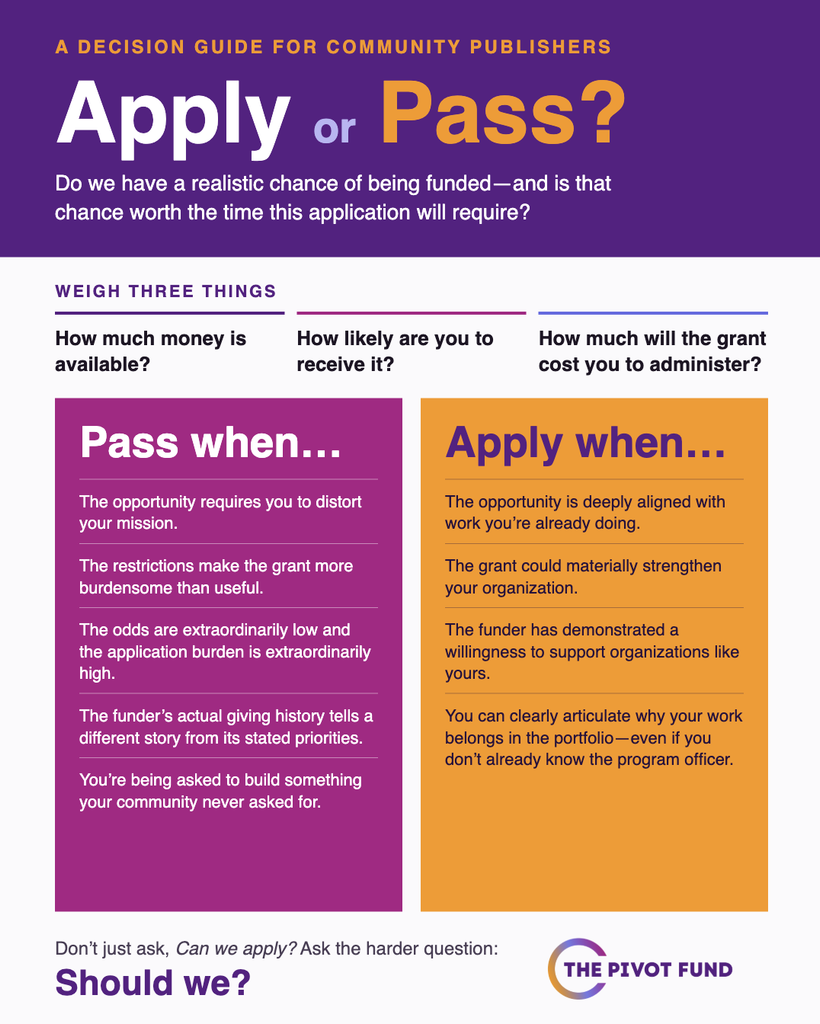
Ask instead: Do we have a realistic chance of being funded—and is that chance worth the time this application will require?
Those are very different questions.
A funder may technically accept applications from organizations like yours while historically funding organizations that look nothing like yours. A grant program may advertise support for local journalism while prioritizing organizations with national reach. A foundation may say it supports underserved communities while making few grants to organizations actually rooted in those communities.
Eligibility gets you through the door.
It doesn’t tell you whether anyone intends to answer it.
So before investing hours—or days—into an application, do some homework.
Look at who the funder has supported during the past two or three years. Look at grant amounts. Geography. Organizational size. Leadership. And, importantly, whether the foundation is still making direct grants to organizations like yours.
If you can’t find that information, ask.
Calculate the Real Cost of Applying
Grant applications aren’t free.
Every hour a publisher spends assembling budgets, answering essay questions, collecting attachments and sitting through multiple interviews is an hour that isn’t being spent running the newsroom, generating revenue, building audience or serving the community.
That tradeoff is particularly consequential for small organizations.
Before applying, estimate the staff time required from beginning to end—not just to submit the application, but to participate in interviews, provide follow-up information and meet reporting requirements if you win.
Then weigh that against three things:
How much money is available? How likely are you to receive it? And how much will the grant cost you to administer?
A $20,000 highly restricted grant requiring 30 hours of application work and extensive reporting may be less valuable than it appears.
Sometimes the smartest fundraising decision is to pass.
Look for Alignment, Not Just Money
One of the easiest mistakes to make when money is scarce is reshaping your work to fit someone else’s funding priorities.
A foundation announces money for artificial intelligence, so suddenly your newsroom needs an AI strategy.
The next opportunity emphasizes civic engagement, so you invent a civic engagement project.
Then comes health information. Climate. Elections. Youth. Entrepreneurship.
Soon, you’re running six projects because six funders wanted six different things—and none of them is paying for the infrastructure required to keep your organization alive.
Funding should accelerate your strategy, not constantly rewrite it.
Ask yourself:
If this grant didn’t exist, would we still want to do this work?
If the answer is no, think very carefully before applying.
Pay Attention to Restrictions—and Flexibility
A six-figure grant can still be the wrong grant.
If the funding can only support a new project, but what you desperately need is money to retain the reporter already serving your community, that’s a problem.
If the grant requires you to hire before receiving the money, that’s a problem.
If it reimburses expenses months later and you don’t have sufficient cash reserves, that’s a problem.
If it requires a match you have no realistic way to raise, that’s a problem.
Read the fine print before falling in love with the dollar amount.
And look for funders willing to recognize that circumstances change.
The Black By God and AfroLA examples illustrate why flexibility matters. One newsroom needed leverage to retain a critical reporting position. Another needed immediate liquidity to make payroll during a natural disaster. Neither situation could have been neatly anticipated a year earlier in a grant proposal.
At Pivot, we believe flexible capital matters because community-rooted organizations need room to respond to what their communities actually need—not simply what someone sitting hundreds or thousands of miles away anticipated when a grant agreement was written.
Relationships Still Matter
Here’s another reality of philanthropy that we should be more transparent about: Cold applications are difficult.
That doesn’t mean you shouldn’t apply without a relationship. It means you should understand the landscape.
Before spending substantial time on an application, try to have a conversation with the program officer. Attend the funder’s webinar. Ask a trusted intermediary or colleague whether they know the program. Send a short email describing your organization and ask whether the opportunity sounds aligned.
And ask direct questions:
Are organizations like ours genuinely competitive for this opportunity?
How many grants will you make?
How many applications do you expect?
Have your priorities changed since your last funding cycle?
A good funder should be willing to help you determine whether applying makes sense.
Saving a nonprofit 20 hours on an application it has almost no chance of winning is also a form of supporting the field.
Know Your Walk-Away Point
Perhaps the most important fundraising discipline is knowing when to stop chasing money.
Pass when the opportunity requires you to distort your mission.
Pass when the restrictions make the grant more burdensome than useful.
Pass when the odds are extraordinarily low and the application burden is extraordinarily high.
Pass when the funder’s actual giving history tells a different story from its stated priorities.
Pass when you’re being asked to build something your community never asked for simply because someone has money for it.
And sometimes, apply anyway.
Apply when the opportunity is deeply aligned with work you’re already doing. Apply when the grant could materially strengthen your organization. Apply when the funder has demonstrated a willingness to support organizations like yours. Apply when you can clearly articulate why your work belongs in the portfolio—even if you don’t already know the program officer.
The point isn’t to become so cautious that you stop taking chances.
It’s to become strategic about which chances are worth taking.
For small, independent newsrooms navigating an increasingly difficult funding environment, that distinction matters.
You cannot control when a funder changes strategy. You cannot control whether philanthropy consolidates its giving. You cannot control when a federal grant disappears, a natural disaster upends your finances or a $150,000 hole unexpectedly appears in your budget.
But you can become more disciplined about where you invest one of your organization’s scarcest resources:
your time.
Before the next application lands on your desk, don’t just ask, Can we apply?
Ask the harder question:
Should we?