
News
How Small Publishers are Innovating with AI
September 19, 2024
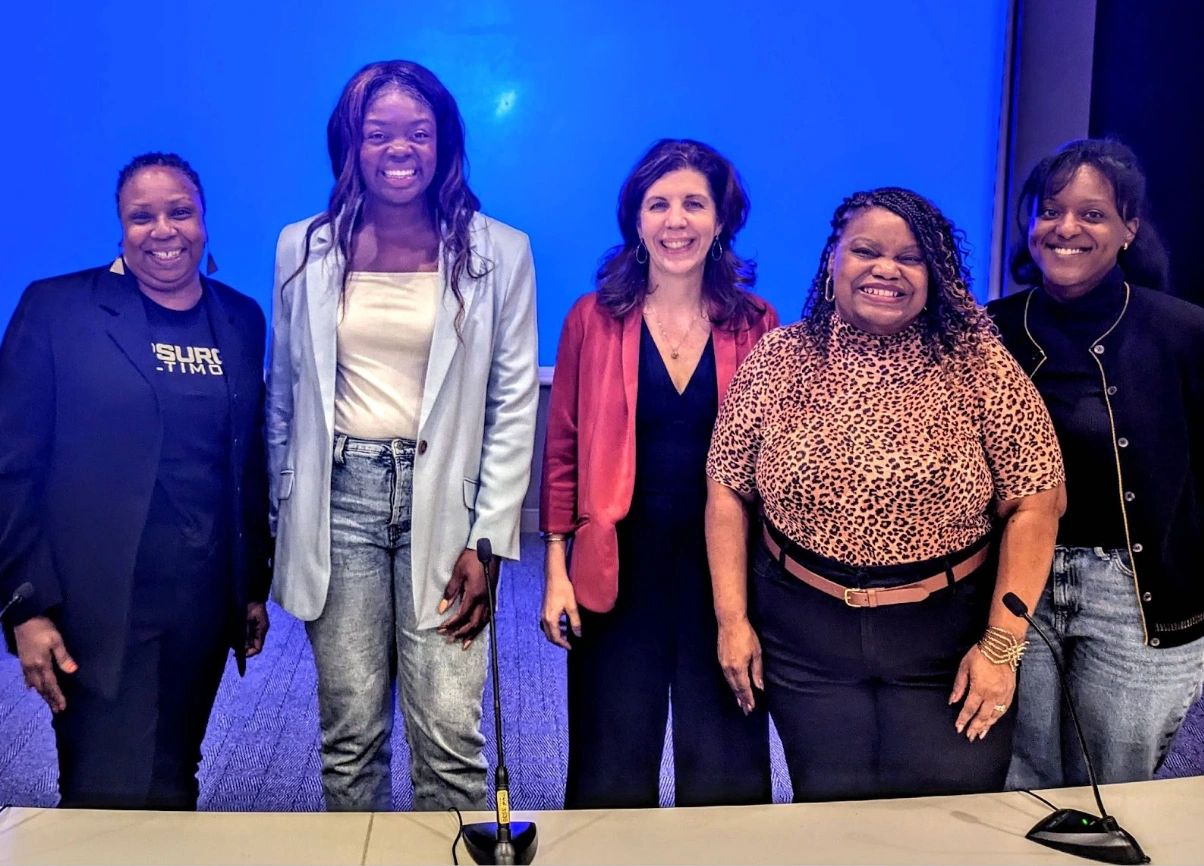
Vania André, editor-in-chief of The Haitian Times, is leading a quiet revolution.
She has transformed her newsroom with artificial intelligence. For André, AI isn’t a futuristic tool reserved for tech giants—it’s a lifeline for her small, community-focused newsroom. She uses technology to help fill in the gaps.
“ChatGPT has become an essential part of our workflow,” André said during a training session organized by The Pivot Fund and The Associated Press, ahead of the annual Online News Association (ONA) conference.
She took time out to attend the conference in Atlanta despite the chaos unfolding in her own publication, where her team is facing death threats after reporting on false claims about Haitian immigrants in Springfield, Ohio, allegedly eating pets.
André has trained ChatGPT to mirror the voice, tone, and cultural nuances of The Haitian Times. By uploading the publication’s style guide and a list of story types, she’s created a model that can quickly turn raw information into fully drafted articles.
“There’s no shortcut to crafting a style guide that reflects our community’s language, history, and culture,” André notes. “But once it was done, integrating it with AI took just 20 minutes.”
Now, the model writes like a seasoned Haitian Times reporter. It doesn’t just churn out stories; it formats them for WordPress, optimizes them for SEO, and even drafts captions and social media posts. What used to take hours can now be done in minutes, freeing up her team to focus on fact-checking and deeper reporting.
Paris Brown, associate publisher of the Baltimore Times, is also pushing the boundaries of AI in journalism. When her paper didn’t have the manpower to cover a youth event, she used ChatGPT to generate an article from the organizer’s notes, framing a series of event photos that otherwise might not have made it to publication. “The community response was incredible,” Brown shared. “They saw themselves in our coverage, and that’s what we’re here for.”
But Brown’s AI use doesn’t stop at writing articles. She’s been exploring ways to use AI tools like DALL-E, an image generator, to create visuals for stories. For an event celebrating Black cyclists, she used AI to create personalized digital covers featuring participants against the Baltimore skyline, which helped foster deeper community engagement. This immersive and innovative approach, blending AI-generated art with journalism, allowed her to bypass expensive photo agencies and offer something uniquely personal to readers.
These AI tools don’t just save time; they open up new opportunities for storytelling. Brown has even used ChatGPT to review stories and identify coverage gaps, suggesting follow-up pieces or new angles on ongoing issues. “It’s like having an extra set of eyes on the story,” Brown says. “AI helps us catch things we might otherwise miss, or come up with ideas we wouldn’t have thought of.”
But despite their enthusiasm, both André and Brown are clear: AI is an assistant, not a replacement. Each story generated by AI still goes through human review to ensure accuracy and uphold journalistic integrity. “The human element is non-negotiable,” André emphasizes. “AI helps us do more, but we have to guide it.”
This careful balance between innovation and ethics is key as more newsrooms, large and small, begin to embrace AI. These tools are increasingly affordable, easy to use, and incredibly powerful. What once required coding skills can now be done with a few clicks. The myth that AI is only for big tech-driven companies is fading fast, thanks to local and community journalists who are showing that with the right approach, small publishers can innovate too.
For newsrooms like The Haitian Times and The Baltimore Times, AI is proving to be more than just a buzzword—it’s a practical, powerful tool that helps them do more with less, ensuring their communities remain informed, engaged, and represented.
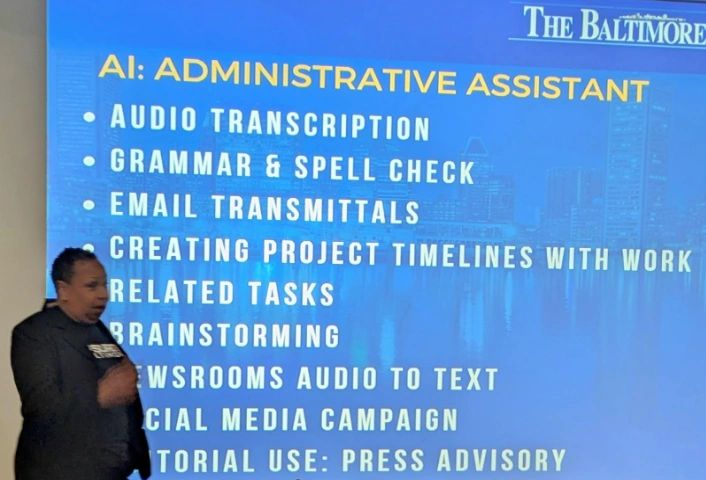
With just 3 1/2 staff, Paris Brown has made ChatGPT a full-time assistant
“You have to think outside the box; this is not the same approach we’ve been using for 35 years,” remarked session participant Francis Page, Jr., publisher of Houston Style Magazine in Houston, Texas.
Participants like Page were able to sign up for free ChatGPT and IFTTT accounts and were invited to try the AP Stylebook for free for 30 days to read the chapter on AI and decide whether to subscribe.
Another participant, Zuri Berry of the Baltimore Banner, noted that an audience survey yielded so much data that he used AI to analyze it, surfacing the issues most important to respondents. Indeed, AI tools excel with large datasets, such as the AP election data available to local publishers through the Knight Election Hub. André demonstrated how she used AI to mine the data for relevant ideas for graphics, subsequently producing the graphics themselves.
Presenter Adriana Lacy summarized the session by stating that AI can be utilized for automated content creation, including writing, summarizing, and editing. It can also assist with fact-checking and verification, as well as managing large amounts of data.
“It gives journalists much more time to do what matters—to be out talking to people,” she said. However, accuracy remains a challenge. AI tools often guess at answers to fill in gaps in their knowledge.
“A human must review everything produced by AI,” she emphasized. She also highlighted that the journalistic use of AI must adhere to a code of ethics.
In addition to creating custom models, ChatGPT subscribers can benefit from a wide range of GPTs developed by others, including visual tools like Canva and the AI image generator DALL-E. This feature, which makes ChatGPT—available for $20 a month—the primary AI tool for session presenters, also includes Claude.ai and Gemini as alternatives. (The site you.com offers access to half a dozen AI agents for the same monthly price, though DALL-E requires a separate subscription).
Lacy demonstrated how Claude.ai could save time in administrative tasks. Once an individual project is created, such as a teaching course, a prompt like “remind my students their presentation is due” generates a precise email detailing the presentation and its due date.
The ONA conference is packed with sessions on using AI for journalism, including many highly sophisticated tactics. But the pre-conference event showed how small newsrooms are already leveraging these technologies to enhance their storytelling capabilities, engage more deeply with their communities, and operate more efficiently. Necessity, it is said, is the mother of invention.