
Resources
4 Things You Need to Know Before Signing That Grant Agreement
June 8, 2023
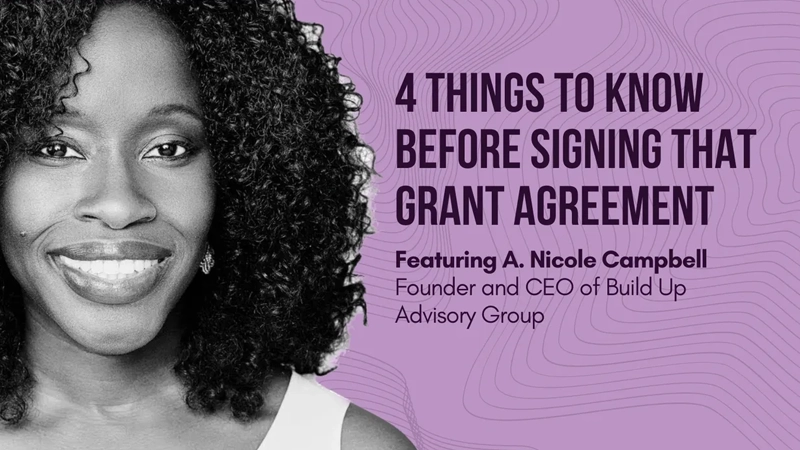
Grant agreements are an important part of the grant-giving (and getting) process.
As part of her video series on nonprofit infrastructure design, A. Nicole Campbell, founder, and CEO of Build Up Advisory Group, shared four critical components to include in these agreements.
“For funders, the more efficient and robust your grant process and grant-making are, the better you can partner with organizations and individuals around the world to effect change,” Campbell said. “And as a grant recipient, grants can provide the capacity you need to build the foundation and capacity to do your best work.”
Lead Build Up Advisory Group is the only advisory firm focused exclusively on helping philanthropies, nonprofits, and individuals build and transform their infrastructures. The group offers a variety of services including creating grant-making and governance processes, building organizational capacity, and improving board accountability.
Campbell has drafted, revised, and negotiated thousands of stateside and international grant agreements as in-house counsel and in her current role.
She explained that grant agreements are more than a technical tool.
“It’s the formal start of a funding relationship that should accurately reflect and support how you’re going to work together for vulnerable and marginalized communities,” said Campbell, who previously served as in-house counsel for Dalio Philanthropies and Open Society Foundations (the latter supports The Pivot Fund).
Here are the four critical components Campbell said every grant agreement should have:
1. Check the tone of your grant agreement
While grant agreements are legally binding documents, that doesn’t mean you have to use clunky legal jargon and not provide explanations.
“At its most fundamental level, this agreement is a communication tool.”
If those involved in the grant do not understand what each provision within the agreement means or requires, they should refrain from signing until the document is revised or renegotiated.
2. The purpose of the grant must be, on its face, charitable
This isn’t inside baseball. Just because you know the grant support will allow an organization to do good work, doesn’t mean the grant purpose should be so vague that only a few people on your internal team know its actual purpose.
“You know you have the right grant purpose when you have a clear, charitable purpose that someone with no context of the work being proposed within the agreement can understand it and sees it as something clearly charitable.”
3. Be clear on the type of support that’s being awarded
For example, if your organization awards a general support grant to a public charity make sure the charitable purpose, spending, and reporting requirements align with what is needed for a general support grant and not a project support grant.
“The implications of getting this alignment wrong can be significant and turn an otherwise flexible grant into a restrictive grant with increased monitoring responsibilities and potential penalties.”
4. State explicitly what is (and isn’t) permitted and expected during the grant term
Be clear, in writing, on what is required from both the funder and the grantee instead of relying on side conversations and verbal agreements. This also includes having clarity on the length of the grant term and making sure each party’s obligations can be addressed in that time frame.