News
The Newsrooms Philanthropy Can’t See
May 27, 2026

As immigrant-serving and community-rooted journalists face legal threats, detention, funding cuts, and political retaliation, some are being forced out of public view altogether.
BY TRACIE POWELL
Across the country, trusted community journalists are losing grants, facing detention, navigating legal threats, and in some cases disappearing from public view altogether — not because their work lacks impact, but because the risks of reporting have fundamentally changed.
At the same time, many of the funders best positioned to help remain too far removed from the communities experiencing the greatest disruption to fully see what is happening.
At The Pivot Fund, we are witnessing these crises in real time.
We are seeing community-rooted newsrooms lose federal support overnight. We are seeing immigrant-serving journalists face escalating threats and legal intimidation. We are seeing trusted reporters alter how they publish — or stop publishing publicly altogether — in order to protect themselves and the communities they serve.
And we are seeing a dangerous gap emerge between where harm is happening and where philanthropic resources flow.
This moment requires more than concern.
It requires infrastructure capable of meeting the moment.
The Cost of Visibility Bias
Too often, philanthropy funds what it can easily see.
Large national outlets, established institutions, and organizations with sophisticated fundraising operations remain within reach of philanthropic networks and visibility. But many of the community-rooted outlets doing the most consequential journalism today operate far outside traditional philanthropic view.
They are small. Hyperlocal. Deeply trusted. Often under-resourced.
And increasingly vulnerable.

This “visibility bias” means the outlets closest to immigrant communities, Black communities, rural communities, and working-class audiences are often the least likely to receive rapid support when crisis hits.
Yet these are the organizations carrying some of the greatest civic responsibilities in the country.
Black By God and the Loss of Federal Support
Black By God, the Black-led news outlet serving West Virginia, recently lost a $350,000 federal grant because of anti-DEI policies. The grant supported an agricultural reporter position at approximately $70,000 annually over five years.
Rather than retreat, the organization launched an emergency campaign to raise $35,000 to sustain the position for another year.

The Pivot Fund agreed to match those donations because losing this reporting capacity would mean far more than one lost newsroom position. It would mean the loss of trusted reporting for Black communities in a state where civic information gaps already run deep.
This is what “meeting the moment” looks like now: helping organizations survive politically motivated funding disruptions quickly enough to prevent collapse.
Journalism Under Threat
The crisis extends far beyond funding.
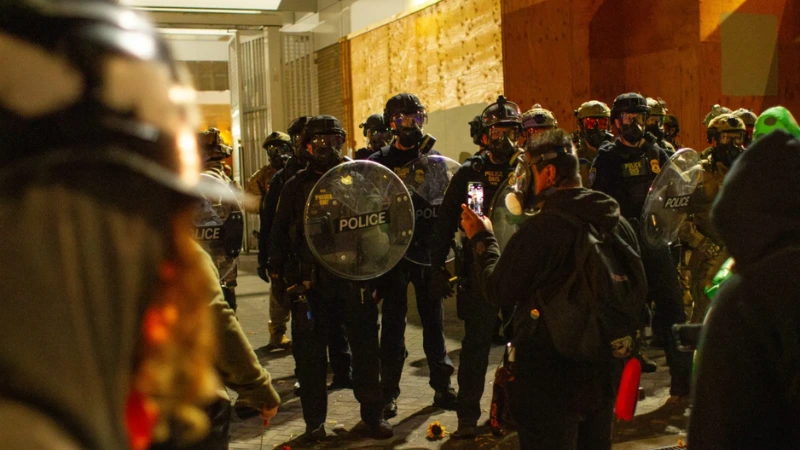
Immigrant journalists and journalists covering immigration are increasingly facing direct threats to their safety, legal standing, and ability to report.
Mario Guevara, the respected Georgia-based Salvadoran journalist known for documenting immigration enforcement and serving Latino communities, was detained by ICE after being arrested while covering a protest, despite clearly identifying himself as press. His detention and deportation raised national concerns about the criminalization of journalism and the vulnerability of immigrant reporters.

Xylom founder Alex Ip has reportedly been forced into self-deportation to a country he barely knows, creating uncertainty around the future of his Georgia-based science publication and the communities it serves.
Nashville Noticias reporter Estefany Rodríguez reportedly faced retaliation after covering ICE raids in Tennessee.
Minnesota journalist Georgia Fort says federal charges tied to her coverage of an anti-ICE protest are now limiting her ability to do her work. Fort, who pled not guilty and is awaiting trial, told The Washington Post that restrictions connected to the case prevent her from speaking with many community leaders and sources central to her reporting.
These are not isolated incidents.
Journalism Going Underground
Perhaps the most alarming shift is one that much of philanthropy cannot yet see.
Independent journalists serving immigrant communities are increasingly being forced underground.
In some communities, reporters and publishers are choosing not to publish certain information publicly online. Some are avoiding websites entirely. Others are reducing social media distribution or relying on encrypted messaging networks and closed community channels to share critical information safely.
This shift is understandable.
Publishing information publicly can expose reporters, sources, and community members to surveillance, retaliation, harassment, or immigration enforcement.
But this also creates a dangerous paradox for the broader information ecosystem.
The people best positioned to support immigrant communities — advocates, funders, policymakers, civic leaders, and allied institutions — become less able to see the disruptions happening in real time because the reporting itself is becoming less publicly visible.
The journalism does not disappear.
It simply becomes harder for the outside world to witness.
And when philanthropy relies heavily on visibility, scale, institutional familiarity, and traditional audience metrics, invisible journalism becomes unfundable journalism.
The Infrastructure Is Fraying
Federal funding cuts are compounding the crisis.
Underscore News, an Indigenous-led newsroom, recently lost federal funding that helped support personnel costs tied to Report for America fellows. One fellow was recently laid off as a result.
Across the country, community-rooted outlets are reducing staff, scaling back coverage, delaying expansion plans, and struggling to maintain basic operational stability as political attacks and economic pressures intensify.
The organizations most trusted by vulnerable communities are increasingly being asked to operate under extraordinary conditions with little long-term resiliency support.
These organizations are not peripheral to democracy.
They are frontline civic infrastructure.
Even Legacy Black Newsrooms Are Disappearing
The warning signs extend beyond newer digital outlets and immigrant-serving publications.
Legacy Black-owned newspapers — institutions that have anchored civic life for generations — are also shutting down.
The Richmond Free Press, a prominent Black-owned weekly newspaper in Virginia, officially ceased publication in February 2026 after decades of serving Black communities and documenting political, cultural, and economic life often ignored by mainstream media.
Just weeks earlier, The Skanner, one of Oregon’s foundational Black-owned newspapers, permanently shut down operations on January 30, 2026, ending a 50-year legacy of community-centered reporting and advocacy.
These closures should not be viewed as isolated business failures.
They are warning signs.
For decades, Black-owned newspapers have functioned as trusted civic infrastructure — documenting injustice, amplifying community voices, preserving local history, and providing accountability reporting in places where traditional outlets often failed to serve Black communities adequately.
When these institutions disappear, communities lose far more than publications. They lose memory, trust, relationships, accountability, and civic continuity built over generations.
Without serious philanthropic investment in resiliency, capacity-building, succession planning, and long-term sustainability, many more legacy Black news organizations may soon face the same fate.
And once these institutions disappear, rebuilding that trust infrastructure may prove nearly impossible.
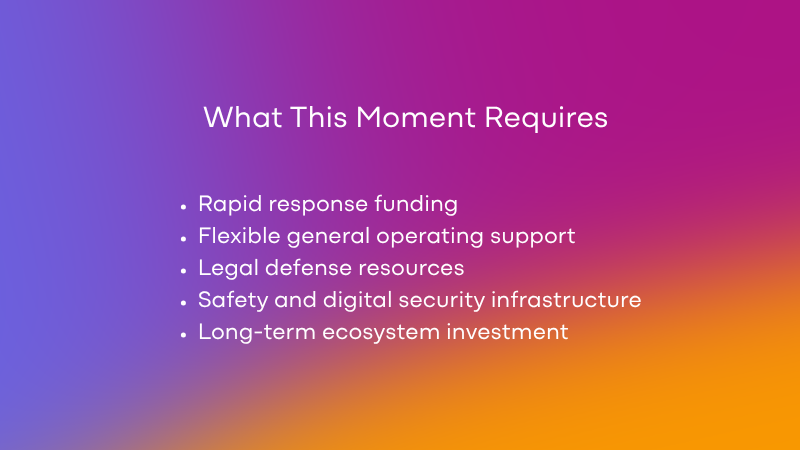
What This Moment Requires
This moment demands more than project grants or slow-moving institutional philanthropy.
- It requires infrastructure funding.
- Rapid response funding.
- Emergency operating support.
- Legal defense support.
- Mental health and safety resources.
- Technology and secure communications infrastructure.
- Flexible funding that allows organizations to respond to rapidly changing threats without waiting months for approval cycles.
The Pivot Fund has been working to raise resources for a rapid response fund precisely because the current environment requires philanthropy capable of moving at the speed of disruption.
Community-rooted newsrooms cannot wait six months while funding committees deliberate whether a crisis is “strategic.” By then, the reporter is gone. The publication has shut down. The source network has disappeared. The trust has eroded.
And rebuilding that infrastructure may take years — if it happens at all.
The Opportunity for Philanthropy
Philanthropy has a meaningful opportunity to meet this moment by:
- Supporting rapid response funding mechanisms for community newsrooms facing sudden crises.
- Investing in intermediary infrastructure capable of identifying urgent needs quickly and equitably.
- Funding legal, safety, and digital security resources for journalists under threat.
- Providing unrestricted operating support rather than highly restricted project grants.
- Expanding support beyond highly visible national organizations to include trusted hyperlocal outlets.
- Funding ecosystem resilience, not just content production.
- Recognizing that journalism serving immigrant and historically marginalized communities may increasingly operate outside traditional public visibility.
The danger is not simply that individual outlets may disappear.
It is that America is steadily losing entire layers of trusted civic infrastructure — particularly within Black, immigrant, rural, and historically marginalized communities.
Some community journalists are already being forced underground. Others are losing federal funding, navigating legal intimidation, or shutting down entirely after decades of service.
The question for philanthropy is no longer whether these outlets matter.
It is whether funders are prepared to invest in the resilience infrastructure necessary to ensure these institutions survive the moment now unfolding around them.