
News
When communities build the public record
January 23, 2026
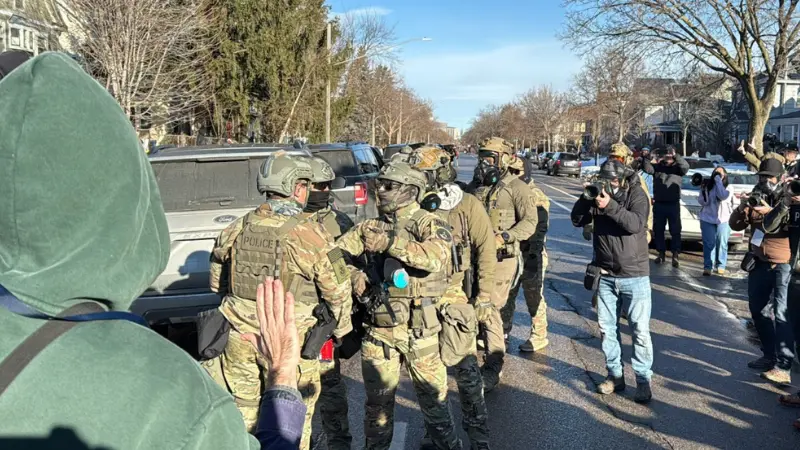
A field update from Minneapolis on what local publishers everywhere are learning: accountability now depends on resourced networks, not press releases.
Field Update
Across the country, local publishers are being asked to cover fast-moving enforcement activity, protests, and public safety incidents with fewer reporters, tighter timelines, and higher stakes. In that gap, communities are increasingly building the public record themselves — through video, livestreams, and firsthand reporting.
Minneapolis offers a clear example.
In recent weeks, residents and independent journalists have documented federal immigration enforcement activity across the metro area. Their reporting has helped surface details, add context, and in some cases challenge early official accounts. It’s a reminder that the public record is being created in real time — often before traditional systems catch up.
At Pivot, this is the work we’re focused on strengthening: community-rooted reporting capacity that doesn’t disappear when a newsroom is understaffed, under-resourced, or shut out.
What we’re seeing: resourced networks fill the gap
What’s unfolding in Minneapolis reflects something we hear from Pivot grantee partners across the country: when power moves quickly, the people closest to events are often the first to document them.
That “first draft” is increasingly built by a resourced local network — independent journalists, community outlets, freelancers, legal observers, organizers, and residents who can record what’s happening before a newsroom can arrive.
This kind of documentation doesn’t replace journalism. But it can expand what journalism can verify, investigate, and preserve.
A concrete example: how the record takes shape
In early January, Renee Nicole Good was killed during an ICE operation in south Minneapolis. As details emerged, the incident quickly became contested territory — and video documentation became central to understanding what happened and what questions remained.
In the days that followed, independent journalist Georgia Fort hosted a closed media briefing and private viewing of sensitive eyewitness footage at the Minnesota Spokesman-Recorder. The briefing brought together local and national outlets to view material that had not yet been publicly released.
“It’s important for the facts of what happened to Renee Good to be portrayed accurately by all media outlets,” Fort told The Pivot Fund. “As a result of our media briefing EMS released their report shortly after which gave key insight that informed nationwide coverage.”
The footage was reportedly provided anonymously out of fear and raised new questions about what happened after Good’s death.
“As a practitioner of trauma-informed journalism, we believe that some footage and photos that are highly sensitive or graphic require consent of family. This is not the assumption or posture of mainstream media. We aim to change that, and that’s why this media briefing was so essential. To demonstrate that even as a small outlet that is trying to grow our audience and our revenue, we can make an empathetic decision to not exploit death for profit. To not exploit death for clickbait. We hope our leadership inspires newsroom leaders to be more considerate in the way they cover trauma through news.”
Soon after, another incident drew attention when video showed ICE agents pulling a woman from her vehicle as she repeatedly yelled that she was disabled — footage that added crucial context beyond official explanations.
The bigger lesson for publishers everywhere isn’t “everyone needs to livestream.” It’s simpler:
When communities document events, publishers have more opportunities to verify, explain, and hold systems accountable — if those relationships and systems are already in place.
What this means for publishers (and what seems to help)
In many places, crowdsourced documentation is already part of the reporting pipeline — arriving through DMs, tip lines, community partners, or trusted local messengers.
A few approaches we’ve seen help publishers work with that material in ways that build trust without adding confusion:
Start with documentation as a reporting lead.
Video can be powerful, but it’s rarely the full story on its own. Many publishers treat community footage the same way they’d treat any strong tip: verify it, report around it, and add context audiences need.
Make it easy — and safe — for people to share.
People often want to share what they’ve witnessed, but they also worry about exposure or retaliation. A clear intake option (Signal, secure email, a simple upload form) makes it easier to contribute safely and consistently.
Build a lightweight verification habit.
Even a simple internal process can help when things move fast:
- Who recorded this and when?
- Where was it taken from?
- What happened right before and after?
- What can we confirm independently?
That structure protects credibility and helps publishers avoid amplifying incomplete or misleading information.
Handle sensitive footage with care.
Some footage strengthens the public record without needing to be published in full. Many publishers are balancing real public-interest value with real human harm — especially in cases involving trauma, disability, or graphic violence. A careful approach (warnings, blurring, stills instead of video, descriptive reporting) can preserve truth without adding harm.
Strengthen the network before a crisis hits.
The strongest accountability coverage often comes from relationships built ahead of time: freelancers who know the community, partner outlets with neighborhood trust, and editorial systems that can move quickly without cutting corners. That’s field-building in practical terms.
Why Pivot is sharing this
We’re publishing this because Minneapolis reflects a wider shift.
In moments of conflict, enforcement, or crisis, accountability depends on whether a community can build a durable record — one that outlasts press releases, fades slower than outrage, and holds up under scrutiny.
Pivot’s grantee partners — and so many independent local publishers beyond our network — are helping make that record possible. Not because they have endless resources, but because they’re trusted, close to the story, and built for the moment.
That’s why investing in independent, community-rooted journalism isn’t optional.
It’s part of the infrastructure communities rely on when the stakes are highest.