
Analysis
Ethnic Media is Local News
March 29, 2023
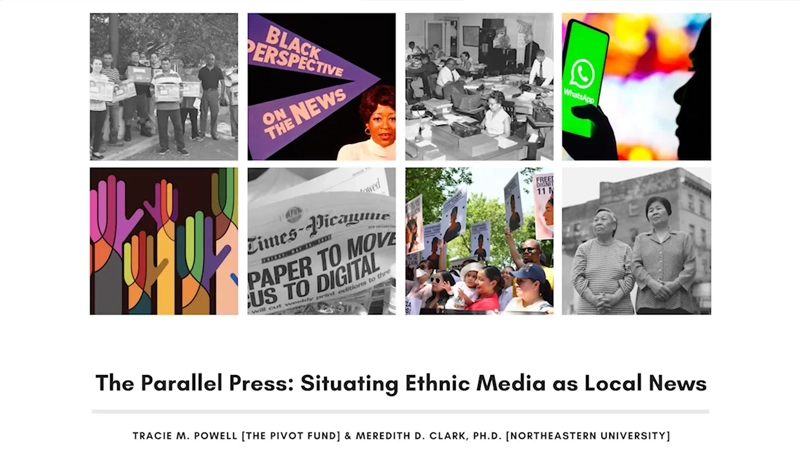
How does the intervention of philanthropic funding impact the health and sustainability of BIPOC-founded news organizations? And what do we even mean when we use the term “sustainability?“
Those questions were at the core of my keynote speech last week alongside Dr. Meredith Clark, founding director of the Center for Communication, Media Innovation and Social Change and associate professor at Northeastern University in Boston.
In our hour, Meredith and I contextualized the real-time impact of BIPOC newsrooms, discussed the actual resources (not the assumed ones) BIPOC-led newsrooms need for sustainability, and gave our insight on potential strategies, not just solutions as that term implies a one-size-fits-all approach.
As promised last week, here are the highlights for those who couldn’t attend. You can find it here if you want to listen to the full conversation.
How trickle-down economics limit BIPOC news media
Between 2009 and 2015, nearly $1.2 billion was invested in news media, yet the lion’s share went to white-led organizations, according to data analyzed by the Democracy Fund. Organizations serving “specific racial and ethnic groups” received 6% of that money; 2% went towards efforts serving immigrants and migrants. Moreover, much of the money meant to support BIPOC newsrooms is primarily filtered through white-led associations to produce training and resources and/or to re-grant much smaller dollars to BIPOC newsrooms. There’s little effort to support capacity building or lead to increased sustainability for BIPOC news outlets.
This approach of making micro-funding contingent upon participation in a program or membership organization harms BIPOC newsrooms’ ability to become more sustainable and hampers their growth. And it’s not a best practice.
You can train the heck out of a newsroom, but if they don’t have the capital to hire staff and add to their capacity to execute on the training, then that money goes to waste.
Last year The Pivot Fund gave a direct grant to BeeTV, a local news outlet in Georgia. Since then, their audience has grown 140 percent, they’ve hired their first sports editor and partnered with Letterhead to produce a newsletter that is on track to generate $124,000 in new revenue. BEE-TV can reinvest those new dollars into producing more coverage about local schools and policing.
Funders need to give directly to these newsrooms and trust their ability to allocate funds in a way that is useful for the organization’s sustainability rather than putting conditions on funding and deciding what’s important for them and their audiences.
The necessity of collaboration
BIPOC news media exists mainly in response to traditional media’s lack of and/or unbalanced coverage.
Corporate media outlets that now want to cover BIPOC communities should know that simply translating an article or assuming what topics are relevant, won’t suddenly bring these audiences to them.
If traditional media wants to move towards authentically serving these communities, they must collaborate and share resources with the BIPOC newsrooms that are already embedded in these communities.
Data and evidence as a way forward
An audience member asked us: “How do we fix this?”
It’s human nature to want a single, comprehensive solution. But many approaches can help us improve conditions for BIPOC news media and the communities they serve. Funders must trust those from these communities to help innovate new strategies to reach and serve them.
One strategy we can offer is creating data and reporting on what works. That’s why Meredith and I wrote our soon-to-be-released joint paper, “Architects of Necessity,” which includes anonymized survey results from more than 100 founders.

Like it or not, funders aren’t likely to believe in new strategies unless they come from an institution they trust. In this case, we’re tapping into the authority and respect that comes with publishing in an academic journal.
Another impact point is constantly elevating to funders the strategies that already exist. During the talk, I spoke about the impact of an independent reporter in Savannah. She was the only person reporting in Spanish when there was a hurricane warning in the area and again when there was a possible school shooter at a local school.
As Meredith put it, we cannot tell you how much it’s worth to a parent to be able to get notified in their native language that something is wrong at their child’s school and what they need to do to take care of their child in the moment.
In this case, and many others, BIPOC-founded media is the only news and information source serving their community directly and that has their trust — a distinctive proposition.
To make real progress, funders must move from the confines of “What is the immediate return on investment?” to “What is the impact potential?”