Resources
What journalism can learn from TikTok’s “Who TF Did I Marry?
March 19, 2024

As I sat in the hair salon, surrounded by the gentle hum of blow dryers and the scent of hair products, I was unexpectedly drawn into the captivating world of “Who TF Did I Marry?” Every woman present seemed entranced by the viral reality series following the tumultuous journey of an Atlanta woman who married, then divorced, her “pathological liar” husband.
The salon’s atmosphere was unlike anything I had experienced before. Conversations dwindled to whispers as all eyes were glued to the screen. Even the sound of the hair dryers seemed to fade into the background as we collectively immersed ourselves in the drama unfolding before us. One woman, her hair wrapped in foil under the dryer, urged us to “turn it up,” unwilling to miss even a single moment of the gripping narrative.
And we weren’t alone. According to The New York Times, the 52-part series has garnered 400 million views in just two weeks, signaling a widespread cultural phenomenon. The article delved into the reasons behind its appeal, citing the allure of melodrama for aging millennials.
The impact of “Who TF Did I Marry?” extended far beyond the confines of the hair salon. It has inspired a movie adaptation and even featured the protagonist on national television, including an appearance on Good Morning America.
Yet, amidst the spectacle, deeper conversations are taking place. Online think pieces began to emerge, dissecting Tareasa “Reesa Teesa” Johnson’s saga and exploring themes of mental illness, American capitalism, homelessness, infant mortality, and maternal health. The series had inadvertently become a mirror reflecting the complexities of modern society.
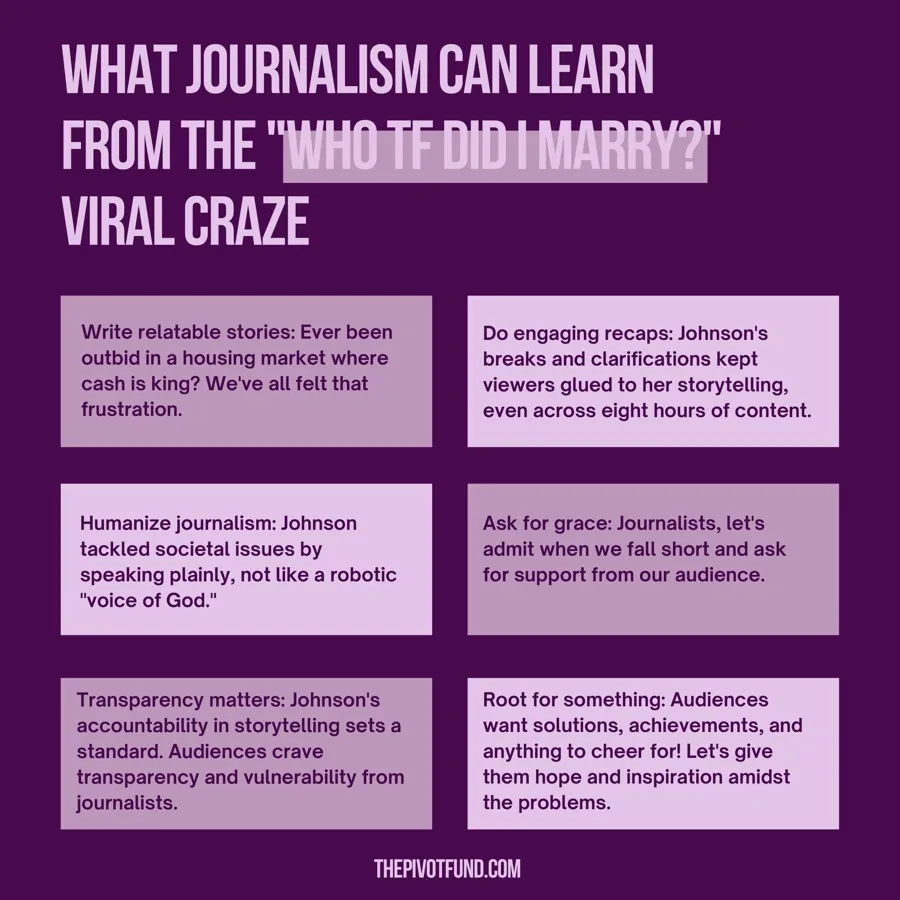
But perhaps the most intriguing lessons were those it offered for journalism and storytelling. In an era dominated by clickbait headlines and sensationalism, “Who TF Did I Marry?” reminds us of the enduring power of narrative. It underscores the importance of authenticity and emotional resonance in capturing audiences’ hearts and minds.
As I left the salon that day, still mulling over the reality series’s twists and turns, I marveled at its ability to spark such fervent discussion and introspection. In a world filled with distractions, it is a testament to the enduring allure of storytelling in all forms.